
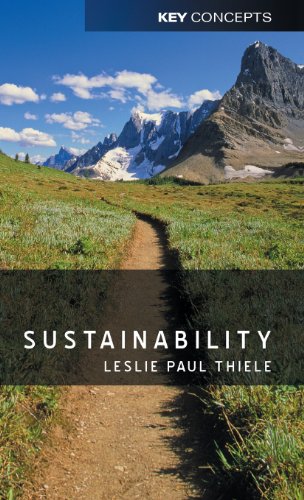
Sustainability / Leslie Paul Thiele.
Series: Key conceptsPublication details: Cambridge : Polity, 2013.Description: viii, 234 p. ; 23 cmISBN:- 9780745656090 (hbk.)
- 0745656099 (hbk.)
- 0745656102 (pbk.)
- 9780745656106 (pbk.)
| Item type | Current library | Home library | Collection | Call number | Materials specified | Copy number | Status | Date due | Barcode | |
|---|---|---|---|---|---|---|---|---|---|---|
| AM | PERPUSTAKAAN TUN SERI LANANG | PERPUSTAKAAN TUN SERI LANANG KOLEKSI AM-P. TUN SERI LANANG (ARAS 5) | - | HC79.E5T453 (Browse shelf(Opens below)) | 1 | Available | 00002106513 |
Includes bibliographical references (p. [218]-229) and index.
1. Sustainability and Time -- 2. The Geography of Sustainability -- 3. Ecological Resilience and Environmental Health -- 4. Technological Solutions and Their Problems -- 5. The Political and Legal Challenge -- 6. Sustaining Economies -- 7. Culture and Change.
The pursuit of sustainability has generated lifestyle changes for individuals across the globe, widespread initiatives within civil society and business, historic policies for municipal, regional, and national governments, and crucial protocols and agreements by international organizations. Increasingly, sustainability provides a common language and goal for diverse peoples and nations. Yet the meaning of sustainability remains unsettled, and the term frequently serves as a PR strategy--a green veneer for business as usual--rather than a driver of fundamental change. Leslie Paul Thiele's accessible yet thorough book provides a broad-ranging introduction to the concept and practice of sustainability today. It addresses the history, scope, and contested meanings of sustainability as an ethical ideal, an ascendant ideology, and a common sense approach to living in an ever more crowded world of increasingly scarce resources. Key topics covered include environmental health and ecological resilience, the promise and unintended consequences of technology, political and legal challenges, economic limits and opportunities, and cultural change. Unlike most other approaches to this crucial topic, Thiele argues that sustainability requires innovation and adaptation as much as the conservation of resources. His book will be a valuable resource for students in a broad range of courses, including environmental studies and related areas, as well as general readers keen to grapple with one of the most pressing issues of our times.
There are no comments on this title.