
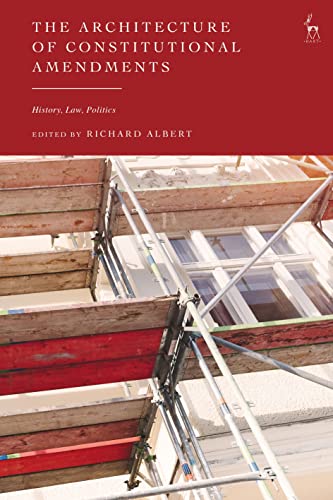
The architecture of constitutional amendment: history, law, politics / edited by Richard Albert.
Publisher: New York: Hart Publishing, Blomsburry Publishing Plc, ©2023Copyright date: ©2023Description: x, 266 pages ; 24 cmContent type:- text
- unmediated
- volume
- 9781509959082
| Item type | Current library | Home library | Collection | Call number | Materials specified | Copy number | Status | Date due | Barcode | |
|---|---|---|---|---|---|---|---|---|---|---|
| AM | PERPUSTAKAAN UNDANG-UNDANG | PERPUSTAKAAN UNDANG-UNDANG KOLEKSI AM-P. UNDANG-UNDANG | - | C21.2 .A7341 2023 2 (Browse shelf(Opens below)) | 1 | Available | 00002253750 |
Browsing PERPUSTAKAAN UNDANG-UNDANG shelves, Shelving location: KOLEKSI AM-P. UNDANG-UNDANG Close shelf browser (Hides shelf browser)

|

|
No cover image available |

|

|

|
|
||
| C21.11.W43154 2 Perlembagaan moden / | C21.11.W65 2 Women and justice development of international policy / | C21.12.E443 2 Emergencies and the limits of legality / | C21.2 .A7341 2023 2 The architecture of constitutional amendment: history, law, politics / | C21.2.F547 2 The handbook of national legislatures : a global survey / | C21.3.B42 2 The ultimate rule of law / | C21.3.B42 2 The ultimate rule of law / |
Includes bibliographical references and index.
Dr. Nurhafilah Musa/ Fakulti Undang-Undang/ hafilah@ukm.edu.my/ 0389216364/ Pemilihan Pensyarah/ OC/ Ashe Enterprise
Introduction : how should constitutions codify amendments? / Richard Albert -- The traces of formalism : the invisible Spanish model of constitutional codification / Patricia Garciá Majado -- The presentist Portuguese Constitution / Catarina Santos Botelho -- Caught between : on the distinctive character of Mexico's model of amendment codification / Jaime Olaiz-Gonzaĺez -- The incorporation of amendments in Paraguayan Constitutionalism / Diego Moreno -- The codification of constitutional amendments in Brazil : beyond the appendative and integrative models / Bruno Cunha -- The form of constitutional amendments in Japan / Masahiko Kinoshita -- When the temporary becomes indefinite : legitimacy, path dependency and Taiwan's hybrid approach to constitutional amendment codification / Hui-Wen Chen -- Amendment politics in South Korea : invisible constitutional replacements in 1960 and 1962 / Jeong-In Yun -- Crafting amendments during political upheaval : amendment models and constitutional stability in Afghanistan / Shamshad Pasarlay -- Codifying secularism in the Bangladesh Constitution / Sharowat Shamin -- The integrative model of constitutional amendments in Indonesia as constitutional communication / Rosa Ristawati and Radian Salman -- The amalgamation of amendment codification models in Ethiopia : a move towards an unwritten constitution / Zelalem Esehtu Degifie -- Amendment codification in Switzerland : codifying an evolving culture of constitutional pragmatism / Caspar Pfrunder -- Between accessibility and oblivion: strengths and weaknesses of the'invisible' Dutch constitutional amendment model / Gert-Jan Leenknegt and Reijer Passchier -- Codification of constitutional amendments as a symbol for transitions : a case study from Hungary / Eszter Bodnaŕ -- One constitution, two models of codification : between trust and distrust towards constitutional interpretations in Albania / Arta Vorpsi -- Georgia's model of constitutional amendment codification / Malkhaz Nakashidze.
'This innovative book blends constitutional theory with real-life political practice to explore the impact of codifying constitutional amendments on the operation of the constitution in relation to democracy, the rule of law, and the separation of powers. It draws from comparative, historical, political and theoretical perspectives to answer questions all constitutional designers should ask themselves: - Should the constitution append amendments sequentially to the end of the text? - Should it embed amendments directly into the existing text, with notations about what has been modified and how? - Should it instead insert amendments into the text without indicating at all that any alteration has occurred? The book examines the 3 major models of amendment codification - the appendative, the integrative, and the invisible models - and also shows how some jurisdictions have innovated alternative forms of amendment codification that combine elements of more than 1 model in a unique hybridisation driven by history, law, and politics. Constitutional designers rarely consider where in the constitution to codify amendments once they are ratified. Yet this choice is pivotal to the operation of any constitution. This groundbreaking book shows why the placement of constitutional amendments goes well beyond mere aesthetics. It influences how and whether a people remembers its past, how the constitutional text will be interpreted and by whom, and whether the constitution will be easily accessible to the governed. A global tour of the high stakes of constitution-making, this book features 18 diverse and outstanding scholars from around the world - across Africa, America, Asia and Oceania, and Europe - raising new questions, opening our eyes to new streams of research, and uncovering new possibilities for constitutional design'-- Provided by publisher.
There are no comments on this title.