
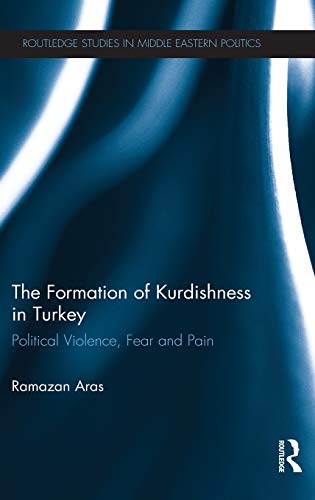
The formation of Kurdishness in Turkey : political violence, fear and pain / Ramazan Aras.
Series: Routledge studies in middle eastern politicsPublisher: New York : Routledge, 2013Description: ix, 227 pages ; 24 cmContent type:- text
- unmediated
- volume
- 9780415824187 (hardback)
- Partiya Karkeren Kurdistane
- Kurds -- Turkey -- History -- Autonomy and independence movements
- Kurds -- Turkey -- History -- 20th century
- Kurds -- Turkey -- History -- 21st century
- Political violence -- Turkey -- History -- 20th century
- Political violence -- Turkey -- History -- 21st century
- National characteristics, Kurdish
| Item type | Current library | Home library | Collection | Call number | Materials specified | Copy number | Status | Date due | Barcode | |
|---|---|---|---|---|---|---|---|---|---|---|
| AM | PERPUSTAKAAN TUN SERI LANANG | PERPUSTAKAAN TUN SERI LANANG KOLEKSI ISLAM-P. TUN SERI LANANG (ARAS 4) | - | DR435.K87A73 ki (Browse shelf(Opens below)) | 1 | Available | 00002118628 |
Browsing PERPUSTAKAAN TUN SERI LANANG shelves, Shelving location: KOLEKSI ISLAM-P. TUN SERI LANANG (ARAS 4) Close shelf browser (Hides shelf browser)


Includes bibliographical references and index.
'The Formation of Kurdishness in Turkey examines political violence, the politics of fear and the Kurdish experience of pain through an analysis of life stories, personal narratives and testimonies of Kurdish subjects in contemporary Turkey. It traces the physical and psychological impacts of the war between the state security forces and the PKK (Kurdistan Workers Party) guerrillas in the last three decades, in Kurdish populated areas in the south-eastern part of Turkey. Focusing on the instrumentalization of violence, the ensuing and manufactured culture of fear, gendered experiences of state violence, pain, incarceration, and corporeal punishment, Ramazan Aras argues that these phenomena have shaped contemporary Kurdish history and memory. Analysing occurrences of various forms of protracted state violence and fear not only as personal and differential markers experienced by individuals, but also as communally-felt phenomena which have engendered collective suffering, this book asserts that these traumatic experiences have marked the social body and produced a prevailing narrative of Kurdishness.Providing an anthropological study of political violence, fear, and pain amongst the Kurdish community in Turkey, this book will be welcomed by students and scholars of Kurdish Studies, Middle East Studies and Anthropology'-- Provided by publisher.
There are no comments on this title.