
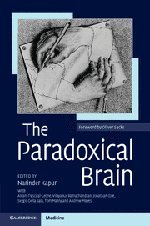
The paradoxical brain / edited by Narinder Kapur ; with Alvaro Pascual-Leone, Vilayanur Ramachandran, Jonathan Cole, Sergio Della Sala, Tom Manly, Andrew Mayes.
Publication details: Cambridge : Cambridge University Press, 2011.Description: xx, 466 pages : illustrations ; 24 cmISBN:- 9780521115575 (hbk.)
| Item type | Current library | Home library | Collection | Call number | Materials specified | Copy number | Status | Date due | Barcode | |
|---|---|---|---|---|---|---|---|---|---|---|
| AM | PERPUSTAKAAN TUN SERI LANANG | PERPUSTAKAAN TUN SERI LANANG KOLEKSI AM-P. TUN SERI LANANG (ARAS 5) | - | QP376.P338 (Browse shelf(Opens below)) | 1 | Available | 00002108166 |
Browsing PERPUSTAKAAN TUN SERI LANANG shelves, Shelving location: KOLEKSI AM-P. TUN SERI LANANG (ARAS 5) Close shelf browser (Hides shelf browser)

|

|

|

|

|

|

|
||
| QP376.L485 Brain builders! : a lifelong guide to sharper thinking, better memory, and an ageproof mind / | QP376.M343 Your mind : the original computer / | QP376.O75 Origins of the human brain | QP376.P338 The paradoxical brain / | QP376.P38 The vertebrate brain / | QP376.P48 Physiological and behavioral effects of food constituents / | QP376.P54 The Brain Changers: scientist and the new mind control / |
Includes bibliographical references and index.
Machine generated contents note: Preface; Foreword Oliver Sacks; 1. The paradoxical nature of nature Narinder Kapur, Alvaro Pascual-Leone, Tom Manly and Jonathan Cole; 2. Paradoxical effects of sensory loss Alvaro Pascual-Leone, Souzana Obretenova and Lotfi B. Merabet; 3. Paradoxical functional facilitation and recovery in neurological and psychiatric conditions Narinder Kapur; 4. Paradoxes in neurorehabilitation Tom Manly, Ian H. Robertson and Narinder Kapur; 5. The paradoxical self Vilayanur Ramachandran and William Hirstein; 6. Paradoxical psychological functioning in early child development David J. Lewkowicz and Asif A. Ghazanfar; 7. Cognitive aging: a positive perspective Shira Zimerman, Lynn Hasher and David Goldstein; 8. Paradoxes of learning and memory Henry L. Roediger, III and Andrew C. Butler; 9. The paradoxical costs of human expertise Itiel E. Dror; 10. Paradoxes in Parkinson's Disease and other movement disorders Ashwani Jha and Peter Brown; 11. Paradoxical phenomena in epilepsy Steven C. Schachter; 12. Paradoxical creativity and adjustment in neurological conditions Indre V. Viskontas and Bruce L. Miller; 13. Paradoxical functional facilitation with noninvasive brain stimulation Umer Najib and Alvaro Pascual-Leone; 14. Unexpected benefits of allergies and cigarette smoking: two examples of paradox in neuroepidemiology Judith Schwartzbaum, Linda Karavodin, Narinder Kapur and James L. Fisher; 15. The paradox of autism: why does disability sometimes give rise to talent? Simon Baron-Cohen, Emma Ashwin, Chris Ashwin, Teresa Tavassoli and Bhismadev Chakrabarti; 16. Paradoxes in creativity and psychiatric conditions Jonathan Hurlow and James H. MacCabe; 17. The paradox of psychosurgery to treat mental disorders Perminder S. Sachdev; 18. The paradox of electroconvulsive therapy Angela Merkl and Malek Bajbouj; 19. Paradoxes of comparative cognition Howard C. Hughes; 20. Paradoxical phenomena in brain plasticity Bryan Kolb and G. Campbell Teskey; 21. Immature neurons in the adult brain: breaking all the rules J. Martin Wojtowicz; 22. The paradoxical hippocampus: when forgetting helps learning Howard Eichenbaum; 23. Paradoxical effects of drugs on cognitive function: the neuropsychopharmacology of dopamine and other neurotransmitter systems Roshan Cools, Esther Aarts and Mitul A. Mehta; 24. The paradoxical brain - so what? Narinder Kapur, Tom Manly, Jonathan Cole and Alvaro Pascual-Leone; Index.
The Paradoxical Brain focuses on a range of phenomena in clinical and cognitive neuroscience that are counterintuitive and go against the grain of established thinking. The book covers a wide range of topics by leading researchers, including: Superior performance after brain lesions or sensory loss Return to normal function after a second brain lesion in neurological conditions Paradoxical phenomena associated with human development Examples where having one disease appears to prevent the occurrence of another disease Situations where drugs with adverse effects on brain functioning may have beneficial effects in certain situations A better understanding of these interactions will lead to a better understanding of brain function and to the introduction of new therapeutic strategies. The book will be of interest to those working at the interface of brain and behaviour, including neuropsychologists, neurologists, psychiatrists and neuroscientists --Provided by publisher.
There are no comments on this title.